
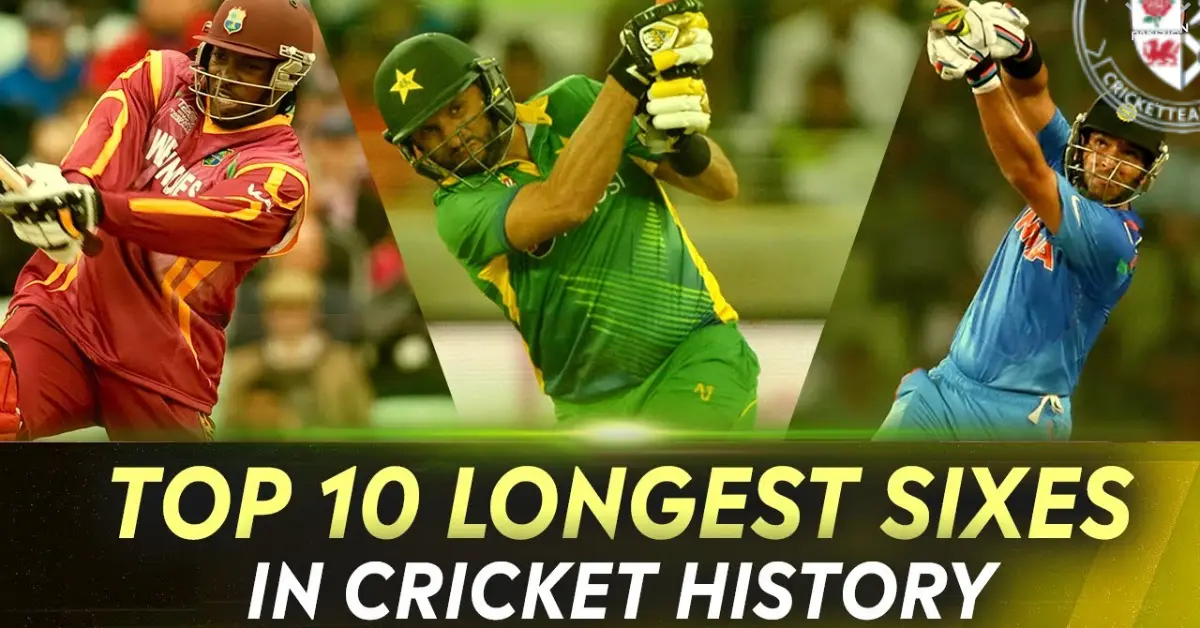
Longest Six in Cricket History | Top 10 Biggest Sixes Ever
The longest six in cricket history has always been more than a number — it’s a measure of raw strength, perfect timing, and breathtaking execution. Every time a batsman sends the ball soaring out of the stadium, fans rise to their feet in awe.
But which six stands at the top? How are these distances measured? And who are the masters behind these colossal hits? This detailed exploration uncovers every answer, tracing cricket’s biggest sixes, the players who made history, and the physics that make these records possible.
What Defines the Longest Six in Cricket
A “six” occurs when the batsman strikes the ball beyond the boundary rope without it touching the ground. But determining the longest six is more complex than it seems. Distance is measured using modern tracking technologies like Hawk-Eye or Smart Ball sensors, which record launch angle, bat speed, and trajectory. Environmental factors — wind speed, elevation, altitude, and even stadium shape — influence the final measurement.
Historically, many of the biggest sixes were estimated rather than verified. In modern cricket, however, distances above 120 meters are officially tracked with precision, giving fans credible benchmarks for the world’s longest sixes.
Historical Overview: From Wooden Bats to Power Machines
Cricket’s earliest six-hitters in the 1970s and 1980s relied purely on timing. As the game evolved, innovations in bat technology, player fitness, and batting technique transformed power hitting. By the 2000s, players like Shahid Afridi, Chris Gayle, and MS Dhoni redefined what was possible. The introduction of T20 cricket pushed boundaries even further, with batsmen routinely clearing 100 m — distances once considered mythical.
Top 10 Longest Six in Cricket History (All Formats)
| Rank | Player | Distance (Meters) | Year | Opponent | Venue |
| 1 | Shahid Afridi | 153 m | 2013 | South Africa | Johannesburg |
| 2 | Brett Lee | 130 m | 2005 | West Indies | Gabba |
| 3 | Tim David | 129 m | 2025 | Australia | Perth |
| 4 | Martin Guptill | 127 m | 2012 | South Africa | Wellington |
| 5 | Albie Morkel | 125 m | 2008 | New Zealand | Johannesburg |
| 6 | Praveen Kumar | 124 m | 2008 | Sri Lanka | Centurion |
| 7 | Corey Anderson | 122 m | 2014 | India | Queenstown |
| 8 | Liam Livingstone | 122 m | 2021 | Pakistan | Headingley |
| 9 | MS Dhoni | 118 m | 2009 | New Zealand | Wellington |
| 10 | Chris Gayle | 116 m | 2010 | India | Johannesburg |
Each of these names has become synonymous with fearless batting. From Afridi’s monstrous strike at altitude to Livingstone’s precision timing in English conditions, every entry tells a unique story of power and artistry.
Format-Wise Longest Sixes
Test Cricket
Tests rarely produce giant sixes, but the longest came from Shahid Afridi’s 120 m shot against Australia in 2002. The crowd erupted as the ball vanished into the stands, proving that even the game’s slowest format has moments of brute force.
One Day Internationals (ODIs)
The ODI format has witnessed some of cricket’s greatest sixes. Brett Lee’s 130 m hit in 2005 stunned fans. MS Dhoni’s 118 m helicopter shot against New Zealand and Yuvraj Singh’s 119 m blast during the 2007 T20 World Cup remain unforgettable.
T20 Internationals
Short-format cricket thrives on big hits. Tim David’s 129 m strike in 2025, Corey Anderson’s 122 m in 2014, and Liam Livingstone’s 122 m against Pakistan in 2021 stand among the most explosive moments in modern cricket.
Indian Premier League (IPL)
The IPL has its own record book.
- Albie Morkel’s 125 m six in 2008 remains unmatched.
- Praveen Kumar’s 124 m and Chris Gayle’s 119 m sixes made the league a spectacle of strength.
These distances demonstrate why the IPL is the heartbeat of power hitting.
Country-Wise Big Hitters
- Pakistan: Shahid Afridi, Imran Nazir, Shoaib Malik
- India: MS Dhoni, Yuvraj Singh, Suresh Raina
- New Zealand: Martin Guptill, Corey Anderson
- England: Liam Livingstone, Jos Buttler
- Australia: Brett Lee, Tim David
- West Indies: Chris Gayle, Kieron Pollard
Each nation has produced iconic hitters who’ve contributed to the evolution of six-hitting artistry.
Evolution of Power Hitting in Cricket
In earlier decades, players focused on technique. Now, biomechanics, strength training, and bat design allow players to hit farther with less effort. Modern bats are crafted from Grade A English willow with thicker edges and balanced weights. Players use pre-shot muscle loading to generate torque, creating explosive bat speed.
Quote from Martin Guptill:
“It’s not about swinging hard — it’s about hitting clean and finding that perfect angle.”
Such insights show how science and skill converge to create jaw-dropping sixes.
The Physics Behind a 150-Meter Six
A six of 150 m requires tremendous power and optimal launch conditions. The formula blends kinetic energy (½ mv²) with bat swing angle (between 35° and 42°). The ball leaves the bat at over 150 km/h, climbing in a parabolic arc until drag slows it down. Even a slight tailwind can add 5–8 m to the distance.
Case Study – Shahid Afridi’s 153 m Six (2013):
- Pitch: Johannesburg (Wanderers, high altitude 1,700 m ASL)
- Bowler: Ryan McLaren
- Conditions: Thin air, dry outfield, fast ball speed Afridi connected with perfect elevation and timing. Analysts estimated the launch speed at 154 km/h, explaining why that shot remains the longest verified six in cricket history.
Records Under Debate
Not every “record” six is official. Some unverified claims — like Afridi’s alleged 158 m six in 2005 vs New Zealand — lack technological evidence. Similarly, early 1990s shots by Adam Gilchrist (122 m) and Mark Waugh (120 m) were estimated based on trajectory rather than radar data.
The International Cricket Council (ICC) now mandates advanced measurement tools to maintain accuracy, ensuring fair comparison between eras.
Future of Big Hitting
Experts predict we might soon witness a 160 m+ six. With the rise of muscular all-rounders, lighter bats, and improved biomechanics, such a milestone seems inevitable. Tim David, Liam Livingstone, and Andre Russell represent a new generation capable of rewriting record books.
Cricket boards are also experimenting with AI-based analytics that calculate real-time bat velocity and impact force, offering new insights into six-hitting dynamics.
Verified vs. Estimated Sixes
| Player | Reported Distance | Verified? | Year | Source |
| Shahid Afridi | 153 m | ✅ Verified | 2013 | ICC Data |
| Brett Lee | 130 m | ✅ Verified | 2005 | Cricket Australia |
| Liam Livingstone | 122 m | ✅ Verified | 2021 | ECB Records |
| Shahid Afridi | 158 m | ❌ Disputed | 2005 | Fan Estimates |
| Adam Gilchrist | 122 m | ❌ Estimated | 2011 | Commentary Report |
This distinction reinforces the value of data-driven tracking over anecdotal guesses.
READ MORE >>> Pakistan National Cricket Team vs South Africa National Cricket Team Match Scorecard
Memorable Commentary Moments
Big sixes often come alive through the words of commentators:
- “That’s gone out of the park and into orbit!” — on Afridi’s 153 m six
- “Livingstone has just launched a rocket to the moon!” — Sky Sports, 2021
- “That’s helicoptered into the night sky — Dhoni style!” — Harsha Bhogle
Such lines immortalize these moments, giving them a cinematic quality that fans cherish.
Fascinating Facts About Long Sixes
- Most 120 m+ sixes: Shahid Afridi leads with five verified hits beyond 120 m.
- Biggest stadium for sixes: Wanderers Stadium, Johannesburg — high altitude aids distance.
- Fastest bat speed: Measured at 157 km/h (Liam Livingstone, 2022).
- Lightest bat used: 1.1 kg (Chris Gayle, 2016).
- Record for most sixes in a single match: 33 (T20I, West Indies vs South Africa, 2023).
Frequently Asked Questions
Who hit the longest six in cricket history?
Shahid Afridi holds the verified record for the longest six in cricket history — 153 meters against South Africa in 2013.
What is the longest six ever recorded in meters?
The verified distance is 153 meters, achieved at Johannesburg’s high altitude.
Who hit the longest six in IPL history?
Albie Morkel’s 125 m six in 2008 remains the biggest six in IPL records.
Who hit the longest six for India?
MS Dhoni’s 118 m helicopter shot against New Zealand stands as India’s longest official six.
What helps a batsman hit longer sixes?
Bat speed, launch angle, timing, physical strength, and environmental factors all combine to create exceptional sixes.
Conclusion
From Afridi’s thunderous 153 m strike to Livingstone’s calculated 122 m launch, the saga of the longest six in cricket history celebrates power, precision, and passion. Each record tells a story of evolution — of athletes pushing the limits of physics, technology, and human performance.
As cricket continues to evolve, one thing remains constant: that moment when the ball leaves the bat, climbs into the blue, and disappears beyond the horizon — it’s pure magic, a timeless symbol of cricket’s spirit.
Meta Description (150 characters):