
Cricket Pitch Length: Standard Dimensions, Markings & Full Guide
Cricket pitch length is one of the most fundamental measurements in the sport, yet it’s also one of the most misunderstood. Whether you’re a beginner trying to understand the basics, a coach preparing young players, or a cricket enthusiast curious about why pitches follow such precise standards, knowing the exact dimensions of a cricket pitch is essential. The length, width, and markings aren’t just random measurements—they define fair gameplay, bowler legality, batsman reaction time, and the overall balance between bat and ball.
Understanding the pitch thoroughly allows you to appreciate the science, the history, and the rules behind every delivery bowled. When you explore the reasoning behind the 22-yard measurement, the importance of crease distances, and the variations used for junior and synthetic surfaces, you start to see cricket in an entirely new light. This detailed guide will walk you through everything—from standard pitch size and historical origins to measuring techniques, variations, gameplay impact, and expert groundsmanship insights.
What Is the Standard Cricket Pitch Length? (MCC Law 7)
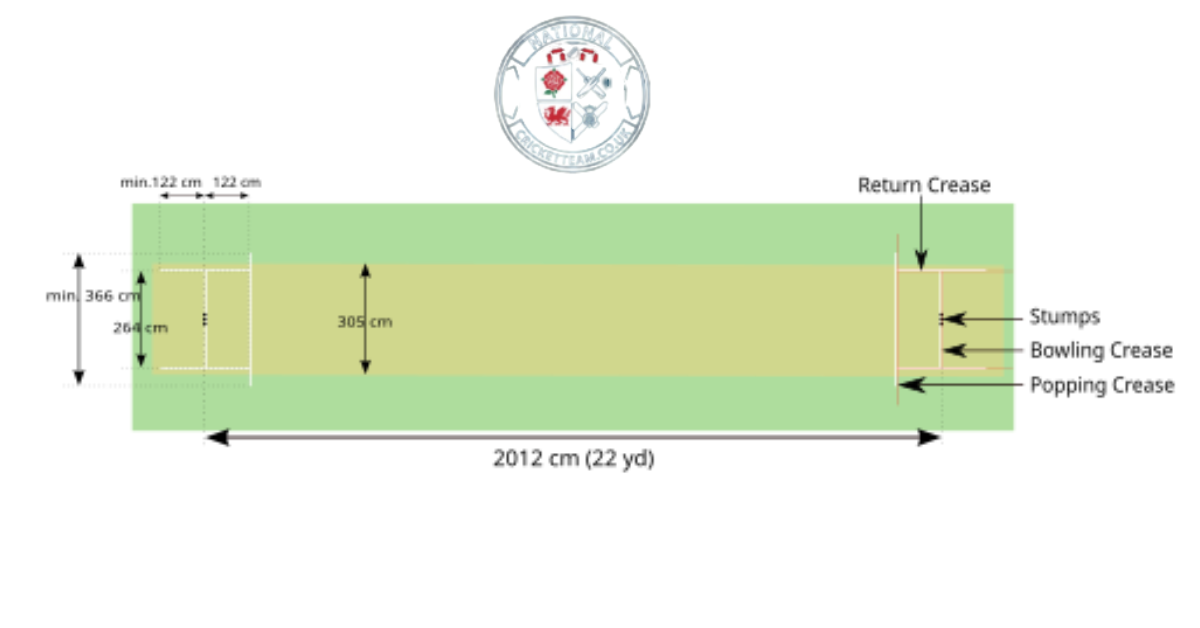
Under the official MCC Laws of Cricket, the standard cricket pitch length is 22 yards, which equals 20.12 meters or 66 feet. This is measured from the center of one set of stumps to the center of the other.
Along with the length, the pitch has a standard width of 10 feet (3.05 meters). These measurements apply globally across all formats: Test cricket, ODI cricket, T20s, and domestic competitions.
Exact Standard Dimensions (From MCC Law 7)
| Component | Measurement | Notes |
| Total pitch length | 22 yards / 20.12m / 66 ft | Stump to stump |
| Pitch width | 10 ft / 3.05m | Fixed globally |
| Popping crease | 4 ft (1.22m) in front of stumps | Used for run outs & no-balls |
| Bowling crease | 8 ft 8 in (2.64m) long | Touches the stumps |
| Return creases | 4 ft 4 in (1.32m) from bowling crease | Determines bowler’s legality |
These measurements are crucial for maintaining fairness and ensuring players follow standardized rules across the world.
Complete Cricket Pitch Dimensions Explained
A cricket pitch includes more than just its length and width. Several important lines and zones determine bowling legality, run-out rules, and where the bowler must land during delivery.
Pitch Length Measurements
The 22-yard measurement is taken from the back edge of the batting crease at one end to the back edge of the opposite crease. This is the most important measurement of the entire pitch.
Width Measurements
Although less discussed, the 10-foot width matters for bowler angles, foot placement, and pitch behavior. Spin bowlers, especially, rely on the width to create wider angles.
Crease Distances
The pitch also includes vital creases that define player movement and umpire decisions.
- The popping crease is 4 feet (1.22m) in front of the stumps.
- The bowling crease runs 8 ft 8 in (2.64m) long.
- The return creases extend 4 ft 4 in (1.32m) behind the bowling crease.
These lines are essential for judging no-balls, stumpings, run-outs, and bowler position.
Why a Cricket Pitch Is 22 Yards Long (Historical Origin)
The 22-yard length is not random—it dates back centuries.
Historically, English land measurement used a unit called a chain, which equals 22 yards. Early cricket pitches were measured using these chains because they were standard tools used by surveyors.
Historical Factors Behind Pitch Length
- A chain = 22 yards
- Early bowling styles evolved around this distance
- Pitch length was long enough to balance bowler and batsman
- Shorter or longer distances created unfair advantages
A famous historian once noted:
“The 22-yard pitch length is perhaps the most elegant compromise in sports history—long enough for reaction time, short enough for excitement.”
This is why modern cricket, despite evolving dramatically, still sticks to this classic measurement.
Cricket Pitch Length Variations (Junior, Amateur & Artificial Pitches)
While professional cricket pitches always follow the standard 22-yard length, other levels of cricket use modified measurement standards.
Junior Cricket Pitch Lengths (Age-Based)
Younger players cannot handle adult distances, so many cricket boards adjust the pitch length.
Age-Based Pitch Length Chart
| Age Group | Pitch Length |
| Under 9 | 14–16 yards |
| Under 11 | 16–18 yards |
| Under 13 | 18–20 yards |
| Under 15 | 20–21 yards |
| Under 17 & above | Full 22 yards |
These distances help players develop correct techniques without being overwhelmed.
Amateur & School Cricket Variations
Local clubs often use:
- Slightly shorter pitches
- Partially synthetic surfaces
- Mixed soil composition
These variations are usually for safety, space limitations, or ground maintenance reasons.
Non-Turf / Artificial Pitch Length
Artificial cricket pitches have strict dimension rules:
- Minimum length: 17.68 meters (58 ft)
- Width: 2.74–3.05 meters
- Concrete base required
These pitches are widely used in schools, training academies, and community grounds.
How Cricket Pitch Length Influences Gameplay
The length of the pitch affects every single aspect of cricket: bowling, batting, timing, decision-making, and even wicketkeeping.
Effect on Bowling
Because the pitch is exactly 22 yards:
- Fast bowlers have predictable bounce and speed consistency
- Seam bowlers rely on the landing distance for movement
- Spin bowlers use the length to deceive batsmen with flight
A shorter pitch would massively favor fast bowlers; a longer pitch would make spin extremely difficult.
Effect on Batting
For batsmen, 22 yards offers:
- Adequate reaction time
- Enough room to judge line & length
- Balanced decision-making
Many coaches train players to read the ball within the first 3–4 meters of the pitch.
Impact on Fielding
Wicketkeepers and slips adjust their positions depending on the:
- Bowler type
- Pitch conditions
- Expected bounce
Every inch of the 22-yard pitch contributes to the game’s rhythm.
How to Measure Cricket Pitch Length (Step-by-Step Guide)
Measuring a cricket pitch accurately is crucial for fairness and rule compliance.
What You Need
- Long measuring tape (30–50 meters)
- Wooden pegs
- Chalk or paint
- String line
- Two sets of stumps
Step-by-Step Measurement
- Lay the measuring tape straight on the ground.
- Mark 22 yards (20.12m) from stump base to stump base.
- Install the stumps firmly at both ends.
- Mark the popping crease 4 feet from each stump.
- Draw the bowling crease touching the stumps.
- Mark the return creases on both sides.
- Recheck alignment using a string line.
Common Measurement Mistakes
- Stumps not perfectly aligned
- Creases marked too short or too long
- Using incorrect measuring tape type
- Tilted stumps changing crease distances
Incorrect pitch dimensions can lead to **illegal deliveries, unfair advantage, and match dis
Understanding Pitch Markings in Detail
Each crease has a unique purpose and directly affects gameplay.
Bowling Crease
This is where the bowler delivers from. If the bowler oversteps it, it becomes a no-ball.
Popping Crease
This determines:
- Run-out decisions
- Stumping decisions
- Whether the batsman has grounded their bat
Return Crease
These lines determine the sideways movement boundary for bowlers. If the bowler’s back foot touches or crosses it, that’s a no-ball.
Types of Cricket Pitches and Their Relation to Pitch Length
Though pitch length stays constant, different pitch types behave differently.
Turf Pitch
Natural soil pitch used in international cricket. Requires:
- Rolling
- Watering
- Top dressing
- Seasonal maintenance
Synthetic/Artificial Pitch
Used in schools and academies. More durable and weather-resistant.
Drop-In Pitch
Used in stadiums like the MCG.
Unique Features
- Built externally
- Transported using machinery
- Maintains consistent length during installation
Pitch Preparation and Maintenance (Expert Groundsmanship)
A pitch’s behavior depends on how well it’s prepared.
Grass Length & Rolling
- Taller grass = more seam movement
- Shorter grass = more spin
- Heavy rolling = low bounce
Moisture Impact
A damp pitch offers swing and seam, while a dry pitch supports spin.
Soil Composition
Pitches with high clay content offer better bounce and longevity.
Pitch Length in Different Cricket Formats
Although the pitch remains 22 yards across all formats, each format uses it differently.
- Test cricket: Longer spells, more wear
- ODI: Balanced conditions
- T20: Harder, flatter pitches for big hitting
- T10: Fastest-scoring format
Some informal formats like street cricket or tape ball cricket use shorter distances.
Professional vs Amateur Pitch Length Differences
Professional grounds maintain extremely strict measurements. Amateur grounds may vary slightly, but ICC events demand:
- Laser-checked measurements
- High-precision marking tools
- Level playing surface within millimeters
Incorrect pitch length can lead to match delays, re-marking, fines, or official warnings.
READ MORE>>>
Case Study: How 1 Foot Can Change the Game
A local club once mistakenly marked the popping crease 5 feet instead of 4 feet, making run-outs unfairly difficult. After correction:
- Bowler no-balls reduced
- Keeper stumpings increased
- Game balance restored
This shows how even small inaccuracies disrupt fairness.
FAQs About Cricket Pitch Length
Why is the cricket pitch 22 yards?
Because the old English “chain” measure was 22 yards, and cricket adopted this standard centuries ago.
Is pitch length different for junior cricket?
Yes, younger age groups use 14–21 yard pitches.
Does pitch length vary in T20 or ODIs?
No, all professional formats use the same 22-yard pitch.
How wide is a cricket pitch?
10 feet (3.05 meters).
What happens if a pitch is incorrectly measured?
The game can be delayed, replayed, or declared unfair.
Conclusion
Cricket pitch length is more than a number—it’s the heartbeat of the sport. The 22-yard measurement, established by history and maintained by strict laws, ensures a perfect balance between bowler and batsman. Understanding pitch dimensions, crease distances, junior variations, and measurement techniques deepens your appreciation for the game.
Whether you’re coaching young players, preparing pitches, or simply learning the sport, mastering these details helps you connect with cricket on a deeper level.