
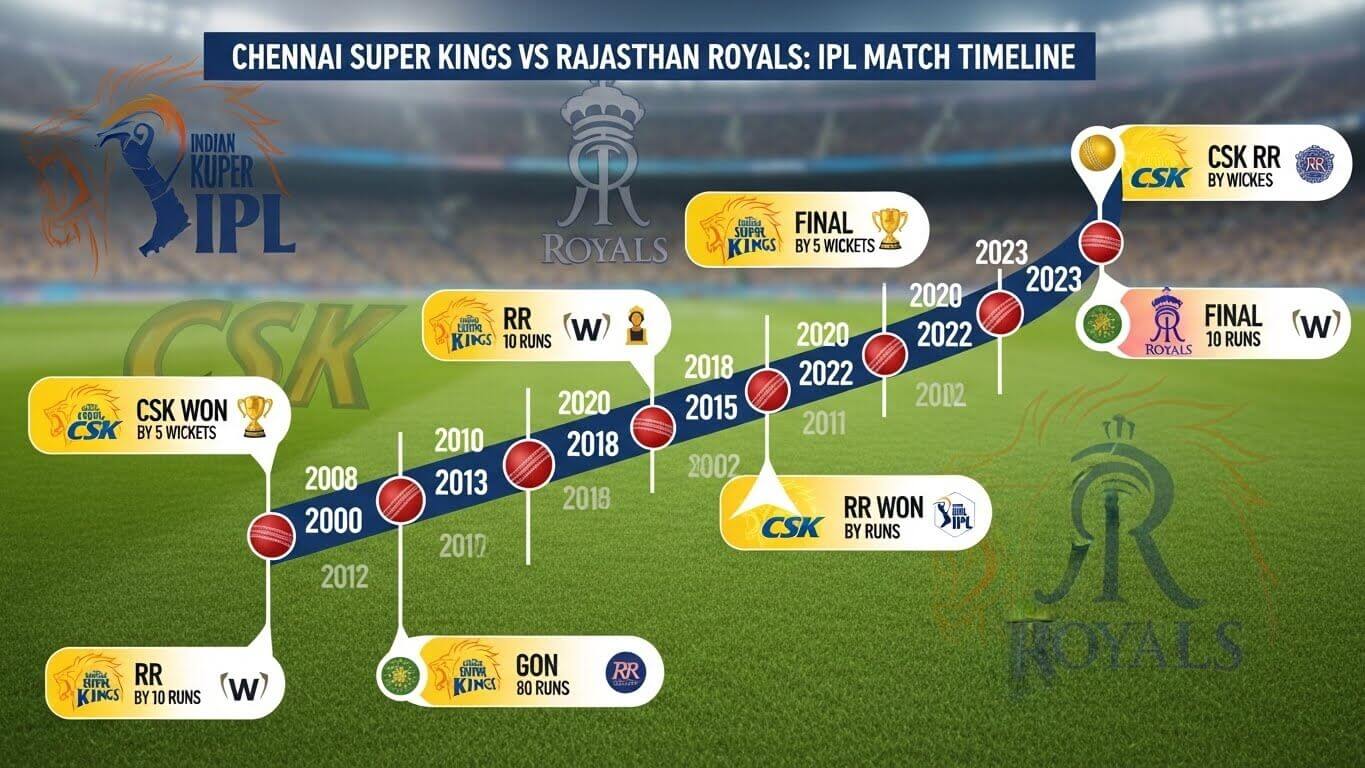
Chennai Super Kings vs Rajasthan Royals Timeline (IPL)
The Chennai Super Kings vs Rajasthan Royals timeline is a chronological way to understand how CSK and RR have met across IPL eras—from the 2008 final that launched the rivalry’s biggest early moment to later seasons shaped by squad changes, a two-year suspension period, and modern T20 scoring trends.
It matters because it connects match results to context (captains, rules, venue shifts) instead of isolated memories. This guide is for Indian fans, students, and writers who want a clear narrative plus reliable sources to confirm dates and scorecards.
Chennai Super Kings vs Rajasthan Royals Timeline
Have you ever tried to recall which season had the “real turning point” in CSK vs RR—only to get stuck scrolling through random posts that don’t match each other? That’s a common frustration, especially in the IPL, where every season has dozens of games, constant player changes, and highlight moments that blur together over time.
This article gives you a clean, reader-first Chennai Super Kings vs Rajasthan Royals timeline that focuses on what fans actually care about: the rivalry’s key eras, the matches that shaped how people talk about these teams, and the big context shifts (like franchise suspension years) that changed the story.
You’ll also get a simple method to verify match details from trusted archives, so you can cite the rivalry confidently—whether you’re writing a blog post, preparing a school project, or just settling an argument in a group chat.
Rivalry overview in one minute
CSK vs RR is best understood as a rivalry of “chapters”: a famous origin, long-term team identity differences, and modern tactical shifts.
Chennai Super Kings and Rajasthan Royals represent two distinct IPL identities:
- CSK is often associated with continuity, calm leadership, and long-term team planning (and is one of the league’s most decorated franchises). The official IPL team page is the safest reference for franchise record context.
- RR is known for bold selection calls, backing young talent, and strong tactical thinking—an approach that began with their early IPL success. Their franchise identity and history are documented on the IPL team page.
This matchup feels interesting because it often becomes a clash of styles:
- “Structured control” vs “creative disruption”
- “Experience-heavy cores” vs “talent discovery and flexibility”
That’s not a guarantee of results. It’s simply the rivalry’s most common storyline.
Why this matchup matters in 2025 for Indian fans
This rivalry stays relevant because it connects to IPL’s biggest themes: leadership, squad churn, and how T20 strategy keeps evolving.
In India, IPL rivalries matter beyond the scoreboard because they are cultural events. CSK vs RR remains a meaningful fixture for three practical reasons:
1) It links directly to IPL’s origin story
Some rivalries begin with a playoff upset years later. This one began with the first-ever IPL final in 2008—a match that still gets referenced whenever fans talk about “how it all started.”
2) It reflects how teams evolve across eras
Squads change every season. Captains rotate. Rules evolve. Yet this fixture keeps giving fans a way to compare:
- Planning vs improvisation
- Experience vs risk
- “Safe Chase” thinking vs Modern high-tempo chases
3) It stays relevant even when players change
A good rivalry survives beyond one star. Even when the playing XI looks different, the fan expectations apkek org and tactical debates remain: “How will CSK manage the middle overs?” “Can RR’s bowling plans hold up at the death?” Those questions keep the matchup fresh.
How this timeline is organized
The IPL is best mapped in eras, not just seasons; this timeline uses major breaks that changed conditions and team identities.
Instead of listing every match (which quickly becomes unreadable), this timeline is built around IPL-era chapters—the moments when context changed:
- 2008 origin chapter (the first IPL final)
- 2009–2015 identity-building chapter (team styles mature)
- 2016–2017 suspension chapter (a real gap in rivalry continuity)
- 2018–2024 modern chapter (return, new cores, and modern scoring trends)
When you want exact dates, venues, and scorecards, you’ll find reliable archives linked in the sources section.
2008–2015: Origin and identity-building years
The early rivalry is defined by the 2008 final, followed by seasons where both teams built their long-term reputations.
2008: The origin match that still defines the rivalry
The rivalry’s biggest “starting point” is simple and verifiable: Rajasthan Royals won the inaugural IPL title in 2008, defeating Chennai Super Kings in the final.
Why this matters for a timeline:
- It gives the rivalry a clear “origin moment.”
- It established RR’s early identity as a smart, well-led team (captained by Shane Warne in 2008).
- It gave CSK an early heartbreak that later became part of their longer story: sustained success built over time.
If you only include one match in a short timeline, the 2008 final is the most defensible choice because it’s official-record material.
2009–2010: The league grows, and so does the tactical gap
As the IPL matured, teams began building stronger roles:
- Powerplay hitters
- Middle-overs control (often through spin)
- Finishers
- Death-over specialists
This is where CSK’s “system” style becomes easier to spot, and RR’s “smart tactical calls” reputation continues.
What fans often notice in this phase: CSK tends to look calmer in pressure chases, while RR often looks fearless in selection and matchups. Those are perceptions, not hard rules, but they shape how people remember games.
2011–2013: Strategy becomes more consistent across the league
By the early 2010s, IPL teams became better at:
- Planning for matchups
- Balancing Indian core players with overseas specialists
- Using data and scouting more seriously
So the rivalry becomes less random. Matches start to feel like:
- “Who won the powerplay?”
- “Who controlled overs 7–15?”
- “Who executed the last two overs better?”
If you’re writing a timeline for Indian readers, this is a good era to explain how T20 tactics matured, rather than trying to recall every scoreline from memory.
2014–2015: Different team paths, same rivalry tension
In mid-decade IPL, franchises often enter different cycles:
- One team stabilises a core
- Another team experiments to rebuild
This period is important for rivalry storytelling because it sets up the next major disruption: a two-year gap where the rivalry disappears from the IPL schedule entirely.
2016–2017: The two-season suspension gap
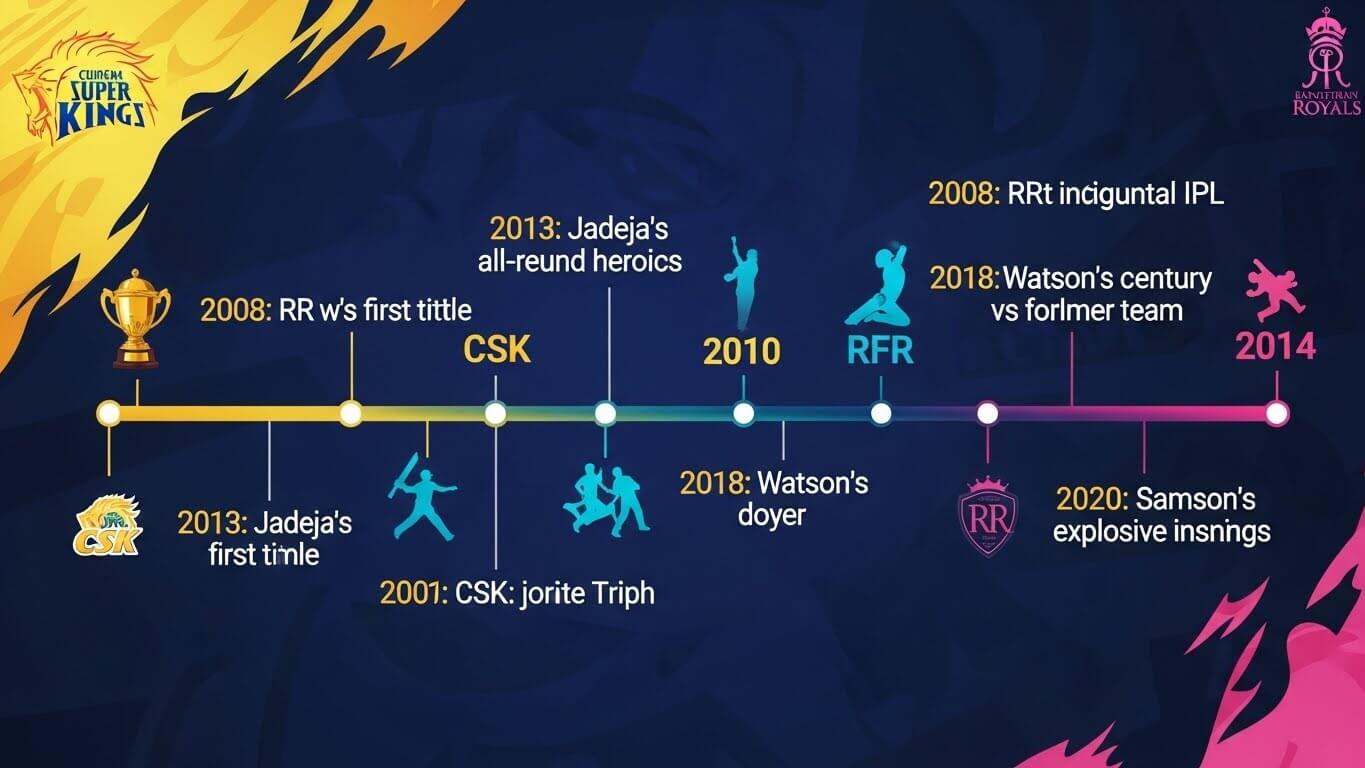
CSK and RR did not participate in IPL 2016 and 2017 due to a two-year suspension, which breaks normal rivalry continuity.
One of the most important “timeline facts” isn’t a match at all: both CSK and RR were suspended for two seasons (2016 and 2017). This happened after disciplinary action linked to the 2013 spot-fixing scandal fallout and subsequent decisions by cricket authorities/committees.
This is widely reported by major cricket media and remains part of modern IPL history. For example, ESPNcricinfo has extensive coverage of the suspension period and related governance decisions.
Why this gap matters for a rivalry timeline
It changes how you interpret the matchup:
- There’s a hard break in momentum and squad continuity.
- Players moved on, leadership groups changed, and team strategies had to restart.
- Fans returned to a “new version” of the rivalry in 2018—same jerseys, different realities.
If your timeline skips this, it feels incomplete.
A simple way to explain it to readers
Think of it like a TV series that pauses for two seasons. When it comes back, the characters are still familiar, but the story has moved forward in a different world.
2018–2024: Return, new cores, and modern IPL trends
After 2018, CSK–RR became a modern rivalry shaped by squad resets, new tactical ideas, and the higher scoring ceilings of T20 cricket.
2018 comeback: the rivalry returns to the schedule
From a timeline perspective, 2018 is a fresh chapter:
- Teams are back.
- Many old combinations are gone.
- New stars and new roles define outcomes.
If you’re creating a timeline page, “2018 return” is a clean milestone marker because it explains why earlier trends don’t always carry forward.
Leadership and identity: why CSK “feels” different from RR
Even with changing squads, these franchises often project different styles:
-
CSK’s continuity model remains one of the most admired approaches in the IPL. Fans associate CSK with long-term planning, stable leadership, and consistent squad retention — a strategy often highlighted by sports analysts and platforms like techleez. Their franchise achievements and standout seasons are well documented in official IPL records, reinforcing their reputation for sustained excellence.
- RR’s tactical risk model: RR is often described as a team willing to back young talent and make bold calls, a reputation that goes back to 2008’s title run.
This is not about who is “better.” It’s about why the fixture feels distinctive.
The T20 scoring curve rises: what it changes in CSK vs RR games
Modern IPL has made one truth louder: totals once considered safe can become chaseable if:
- The powerplay goes big,
- The batting depth holds,
- Boundary options keep coming.
So modern CSK vs RR games often turn on:
- Powerplay intent (fast starts without losing too many wickets)
- Middle-over matchups (especially spin vs hitters)
- Death-over execution (yorkers, slower balls, field placement under pressure)
When you write about this era, you don’t need to invent exact numbers to be useful. The tactical framework itself helps readers understand why matches swing.
2020–2021 context: conditions and scheduling changes matter
The pandemic era affected IPL scheduling and venues. Even when you’re focusing on CSK vs RR, that broader context matters because conditions influence outcomes and strategies.
For credible context coverage, BBC Sport’s cricket reporting is a solid reference hub for major cricket events and season context.
2022–2024: modern squad churn and “reset thinking”
IPL team combinations can change sharply due to auctions, retention rules, and injury/availability shifts. That means rivalry “patterns” can vanish quickly.
The safest way to describe this period is:
- focus on how games are won (phases, tactics),
- anchor any “big moment” to a reliable match report or official scorecard,
- and avoid relying on social-media memory for exact results.
For match-by-match verification, the IPL’s official results archive and ESPNcricinfo’s scorecards are the most practical sources.
Benefits of reading a timeline (and what it cannot do)
A timeline helps you understand context and story, but it doesn’t replace official scorecards for exact stats.
What you gain
A well-structured timeline helps you:
- Remember the rivalry in eras instead of random clips
- Understand why matchups felt different in different years
- Avoid mixing up seasons when writing or discussing cricket
- Build a credible base for analysis (without guesswork)
What a timeline cannot promise
A timeline cannot:
- Predict the next result (T20 is too volatile)
- Replace official records for totals, margins, or player stats
- Stay “Complete” without referencing updated archives as new seasons happen
This honesty improves trust—and avoids the common SEO trap of pretending everything is fixed forever.
Common misconceptions Indian fans run into
The biggest mistakes are confusing names, mixing seasons, and using social clips as “proof” without scorecards.
Misconception 1: “Older matches are missing”
Often, they’re not missing—they’re filed under KXIP style naming issues, chennai super kings vs rajasthan royals timeline in other rivalries, or under older formatting in archives. For CSK vs RR, the main confusion is usually the suspension gap and season context, not team naming.
Misconception 2: “One famous match = overall dominance”
A single iconic game can shape memory, but it doesn’t describe an entire rivalry. Timelines help balance that.
Misconception 3: “If it’s viral, it’s accurate”
Clips are great for nostalgia, but scorecards are what you cite. Use the IPL archive or ESPNcricinfo when accuracy matters.
Best practices: a simple method to verify and write your own timeline
Use official results for dates and outcomes, and a major cricket archive for context; then write one clean sentence per milestone.
Here’s a practical, low-effort approach that works for students and creators:
Step 1: Start with official IPL records
Use the IPL site for:
- Seasons
- Match listings
- Team pages
- Results archive
Step 2: Use a major cricket archive for match reports
Use ESPNcricinfo for:
- Scorecards
- Match reports
- Verified match context and quotes
Step 3: Write “one line of meaning” per milestone
For each milestone, write:
- What happened (fact)
- Why it mattered (context)
Example (structure only, not a claim):
- “Year: Event. Why it mattered: changed expectations / marked a comeback / introduced a new style.”
Step 4: Keep language simple
If your reader is in India and reading on mobile, clarity beats complexity:
- Short sentences
- Fewer acronyms (define once)
- No unnecessary stats without citations
Conclusion
The CSK vs RR rivalry is easiest to remember when you treat it like a story with chapters. punjab kings vs kolkata knight riders timeline, where RR won the inaugural title against CSK. Then comes the long middle entertechpro where team identities mature, followed by a major disruption—the 2016–2017 suspension gap—and finally the modern era where tactics, squads, and scoring expectations move faster than ever.
Next step: if you want the full match-by-match list, use the IPL results archive and cross-check with ESPNcricinfo scorecards. Then you’ll have a timeline that’s both readable and reliable.
What’s your strongest CSK vs RR memory—2008, the comeback years, or a recent thriller?
FAQs
Q1: What is the Chennai Super Kings vs. Rajasthan Royals timeline?
A: It’s a chronological overview of CSK vs RR across IPL eras, highlighting key milestones like the 2008 final, major context changes, and how modern tactics reshaped the fixture.
Q2: Why is the 2008 match so important in this rivalry?
A: The 2008 IPL final is the rivalry’s origin story because RR won the inaugural title against CSK. It’s a verified milestone in the IPL’s official records.
Q3: Why do some timelines show a gap in 2016–2017?
A: CSK and RR were suspended for two seasons (2016 and 2017), so they did not play those IPL seasons. Major cricket media documented this period extensively.
Q4: Where can I verify CSK vs RR match results and dates?
A: Use the IPL official results archive for match listings and ESPNcricinfo for scorecards and match reports. These are the most reliable public references.
Q5: Does a timeline help predict who will win the next CSK vs RR match?
A: Not reliably. A timeline helps you understand context and patterns, but T20 outcomes can swing quickly due to form, conditions, and team changes.
Q6: What’s the biggest mistake people make when writing rivalry timelines?
A: Relying on viral clips or memory for “facts.” For accuracy, always cite a scorecard or an official match record.